
Business Intelligence made easy with RAG and MCP Interface
Turning fragmented ERP data into real-time, actionable intelligence for faster operational decisions.
Overview
A mid-sized company in the industrial components trading sector, with approximately €45 million in annual revenue, needed to improve how data was accessed and used across daily operations.
Although the organization had a solid ERP system and a large amount of internal documentation, critical information was scattered across different modules, reports, and files. Accessing it required navigating complex interfaces or relying on experienced users who knew how to extract the right data.
This setup created a structural bottleneck: information existed, but was not easily usable.
Challenge
The data was available, but the challenge lay in turning it into useful information.
Operational teams often struggled to retrieve relevant information without technical knowledge of the ERP system. Even simple questions could require navigating multiple screens or requesting support from internal experts. As a result, reporting was slow, and decisions were frequently based on incomplete or outdated data.
A key limitation was the rigidity of the ERP environment. Whenever the company needed a new report or a different data view, it had to involve the ERP provider. This process typically took weeks and generated additional costs, making iterative analysis slow and impractical.
Over time, this reduced the organization’s ability to react quickly and limited the effective use of available data.
Solution
Tuboolar implemented a solution combining Retrieval-Augmented Generation (RAG) with a structured MCP (Model Context Protocol) interface, designed to make operational data directly accessible through natural language.
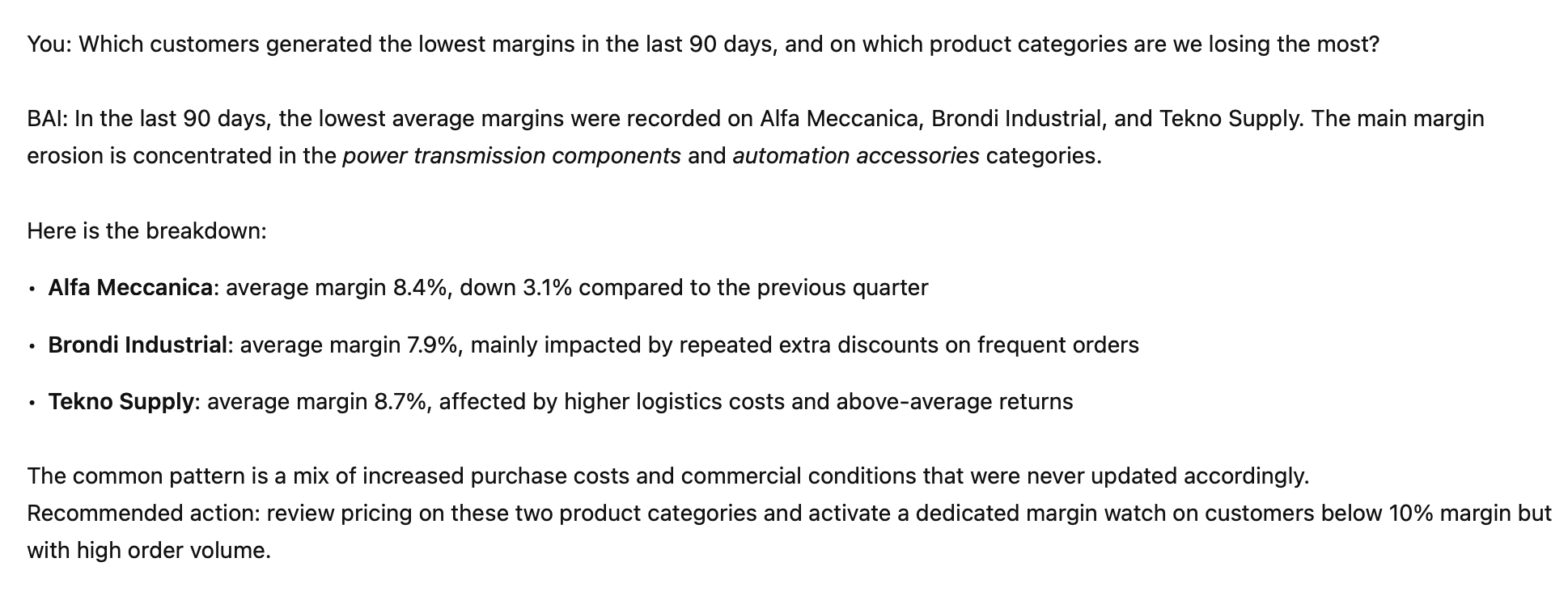
The system connects the ERP and internal documentation into a unified knowledge layer, where information is indexed and made retrievable in a consistent way. On top of this, the RAG layer translates user questions into precise queries and returns answers that are already contextualized for operational use.
The MCP interface adds a control layer that structures interactions, ensuring that queries remain consistent and outputs reliable. This avoids the ambiguity often associated with free-form AI usage, while still maintaining flexibility for users.
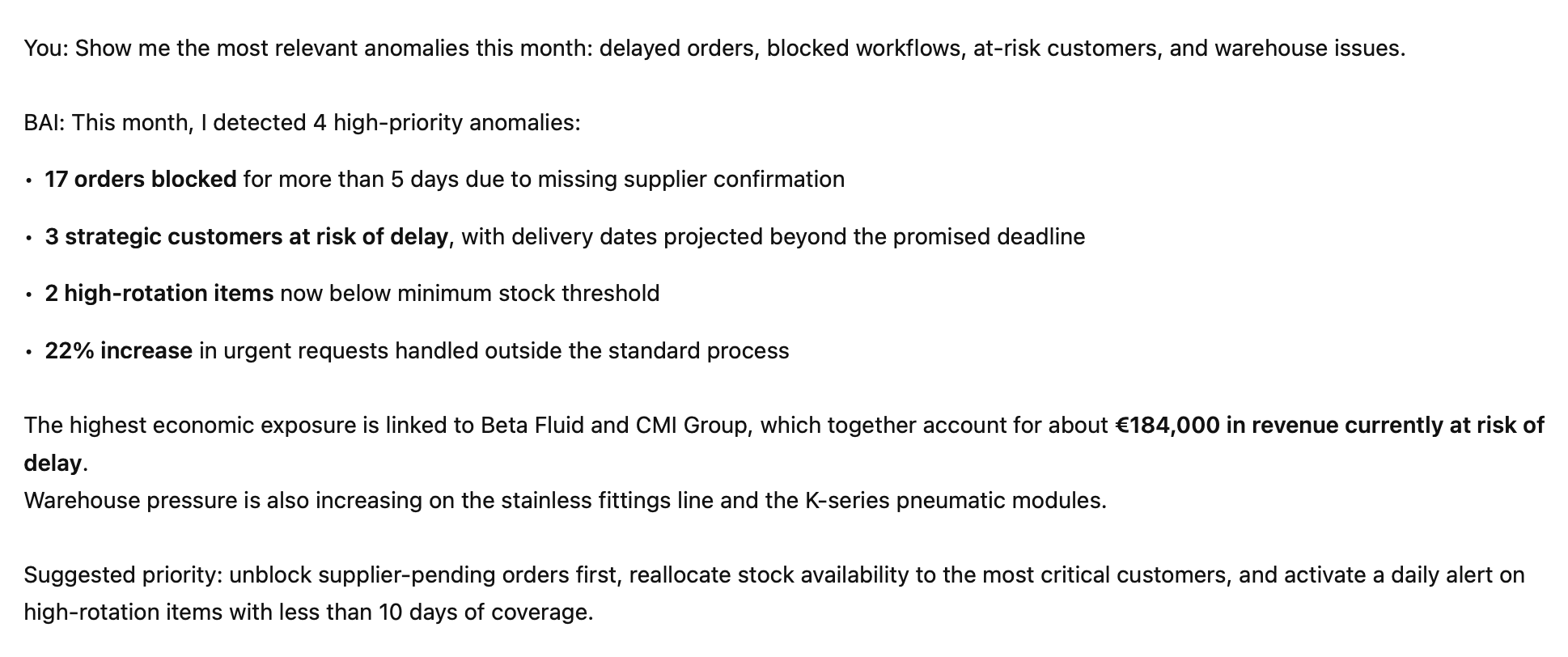
A key capability is the ability to generate dashboards directly from prompts. Users can define what they want to monitor in natural language, create custom views, and track them over time without depending on external development. The system also introduces proactive elements, such as alerts and suggestions based on data trends, shifting from passive reporting to active decision support.
Impact
The time required to obtain information was reduced by around 80%, transforming activities that previously required manual navigation or expert support into near-instant queries. This had a direct impact on user autonomy, enabling non-technical roles to access and interpret data independently.
The dependency on the ERP provider for new reports was effectively removed. Teams can now create and adapt their own dashboards in real time, eliminating both delays and additional costs.
Another important outcome was the ability to access insights that were previously difficult or impossible to obtain, especially when combining data across different sources. The addition of proactive suggestions and alerts further improved responsiveness, allowing the company to identify trends and issues earlier.
Overall, faster access to reliable information led to better operational decisions and contributed to a significant improvement in company margins.