
Automated Defect Detection for Clinical Test Manufacturing
AI-powered visual inspection system to improve quality control, consistency, and throughput in clinical test production
Overview
A diagnostics manufacturing company based in Italy needed to improve the efficiency and reliability of its quality control processes for clinical test devices.
These devices consist of small arrays of containers filled with reagents, requiring precise inspection to ensure product integrity. Manual inspection was the primary method in use, creating variability in outcomes and limiting throughput. As production volumes increased, maintaining consistent quality standards while sustaining operational speed became a critical challenge.
The company’s objective was to automate defect detection as much as possible while preserving human supervision in the most critical validation steps.
Challenge
Manual inspection introduced two structural limitations.
First, it constrained production speed. Human operators could not consistently match the pace required by modern production lines without creating bottlenecks.
Second, it introduced variability. Visual inspection outcomes depended on operator experience, fatigue, and subjective judgment, leading to inconsistencies in defect detection and classification.
At the same time, the production environment required:
- Continuous in-line quality control
- High reliability under sustained throughput
- Traceability of inspection results and non-conformities
Any solution needed to integrate directly into the production process without disrupting operations, while maintaining strict quality standards typical of clinical manufacturing.
Solution
Tuboolar developed an AI-based defect detection system that can be integrated into the production line.
The solution combines computer vision and deep learning to automatically identify defects in clinical devices during production, generating consistent and traceable outputs for quality control.
Key elements of the solution include:
- Automated visual inspection system embedded in the production workflow
- AI model based on EfficientNetV2 architecture for defect classification
- Structured output for traceability and non-conformity management
- Readiness for PLC integration to enable automated quality control actions
The system is designed to support operators rather than replace them, enabling human validation where necessary while removing the burden of repetitive inspection tasks.
Implementation
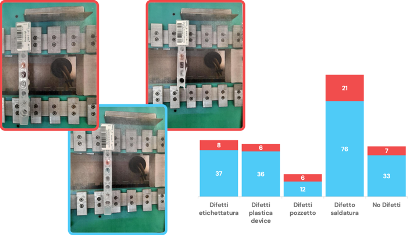
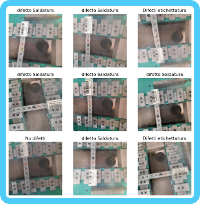
The project began with the creation of a deliberately challenging dataset to simulate real production conditions.
The dataset included:
- 202 defect images
- 40 non-defect images
- High variability and noise to reflect worst-case scenarios
- Approximately 20% of the dataset reserved for validation
The AI model was trained using:
- EfficientNetV2 convolutional neural network
- Aggressive data augmentation techniques
- Regularization and data-efficiency methods to improve generalization
Alternative architectures, including transformer-based models, were tested but found less effective for this specific application.
The system was designed with a clear roadmap toward full production deployment, including future steps such as semantic segmentation and expanded dataset coverage.
Results / Impact
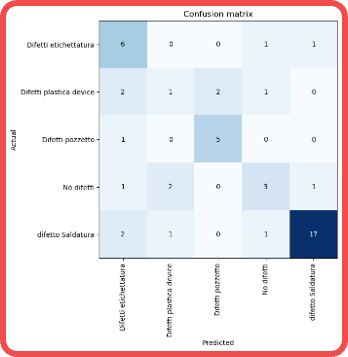
The proof of concept delivered strong initial performance, demonstrating the feasibility of automated defect detection in a real production environment.
Key metrics include:
- Accuracy: 91.67%
- Precision: 92.68%
- Recall: 97.50%
- Sensitivity (non-defect recognition): 66.67%
These results are particularly relevant given the intentionally noisy and limited dataset, designed to replicate challenging real-world conditions.
The system showed high effectiveness in identifying defects, which is critical in clinical manufacturing where missed defects carry significant risk.
The main limitation identified was the underrepresentation of non-defect samples, affecting specificity. This is expected to improve significantly with additional data.
Operationally, the solution enables:
- Reduced dependence on manual inspection
- Increased consistency in quality control
- Scalable inspection aligned with production speed
- Structured traceability of inspection outcomes